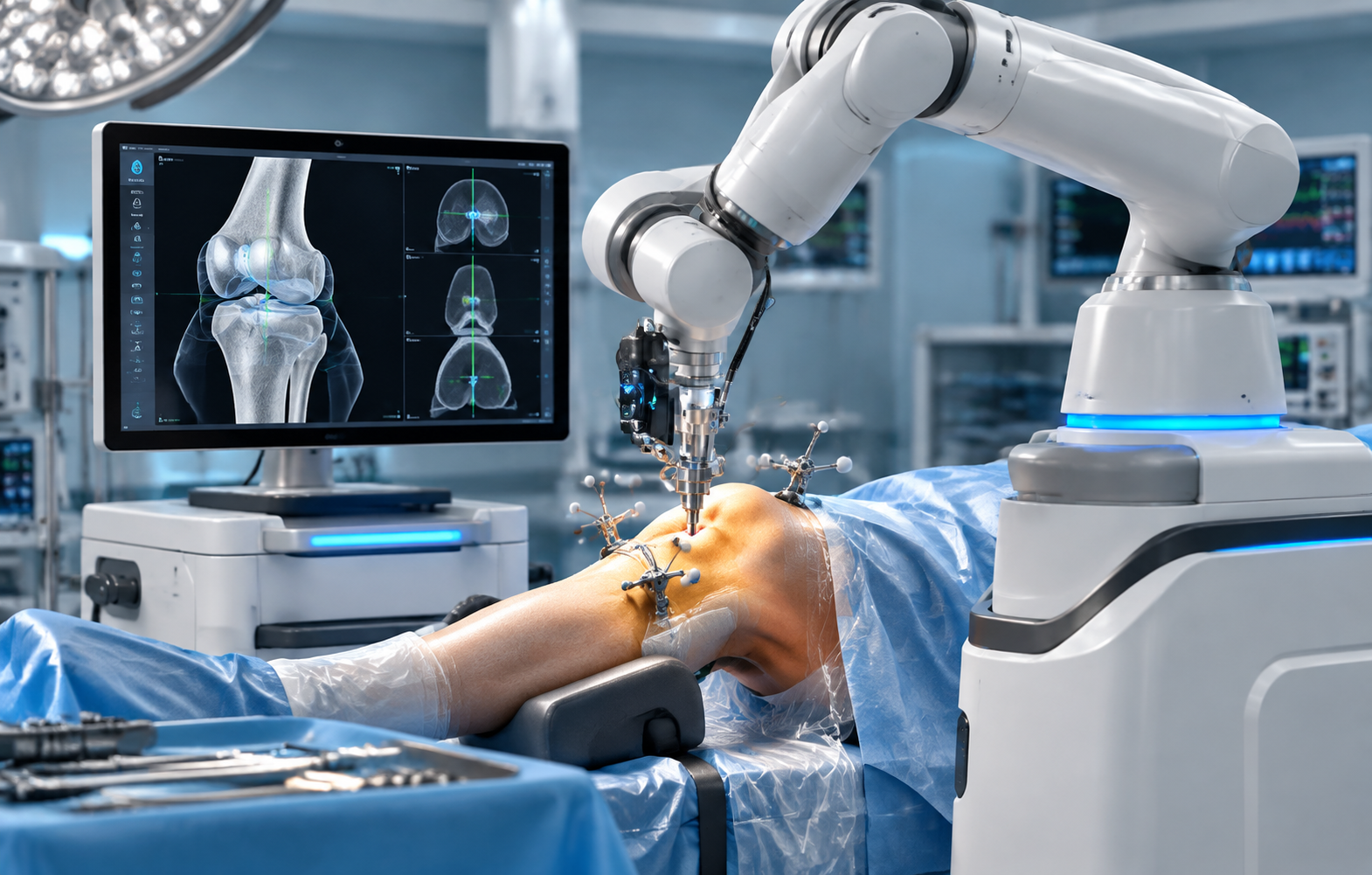
Knee replacement technology has advanced considerably in recent years, giving orthopedic surgeons new tools to improve surgical planning and precision. One important development is robotic-arm-assisted knee surgery. This approach combines a surgeon’s clinical expertise with computer-based planning and robotic guidance to help position knee implants accurately.
For patients considering knee replacement, however, technology alone is not enough. The bigger questions involve long-term results. Does robotic-arm surgery continue to provide strong outcomes several years after the procedure? Do patients remain satisfied? Do the implants remain stable? Research involving Dr. Michael Gaudiani and other orthopedic investigators offers useful insight into these questions through five-year data on robotic-arm-assisted partial knee replacement.
The results paint an encouraging picture, while also showing why surgeons must evaluate outcomes carefully and over time.
Understanding Robotic-Arm-Assisted Knee Replacement
Robotic knee surgery does not mean a robot operates independently. The orthopedic surgeon remains in control throughout the procedure. The robotic system acts as an advanced surgical tool that helps the surgeon plan and execute specific steps.
In robotic-arm-assisted unicompartmental knee arthroplasty, also known as partial knee replacement, the surgeon replaces only the damaged compartment of the knee. The healthy bone, ligaments, and unaffected areas of the joint can remain intact.
Robotic technology can assist with implant positioning and bone preparation. This precision may be especially valuable in partial knee replacement because accurate implant placement and alignment are important for joint mechanics and long-term function.
What Five-Year Data Reveal About Implant Survival
One of the most important questions after knee replacement involves implant survivorship. In simple terms, survivorship measures how many implants remain in place without requiring revision surgery.
A study coauthored by Dr. Michael Gaudiani examined five-year outcomes after robotic-arm-assisted medial unicompartmental knee arthroplasty. The research focused on patients who underwent robotic-assisted partial knee replacement and evaluated survivorship along with clinical outcomes.
Other midterm studies have also reported strong implant survival. One study involving 216 patients and 224 medial robotic-assisted partial knee replacements reported a Kaplan-Meier survivorship rate of 97.8% at an average follow-up of 5.9 years. Only five implants required revision.
Another prospective study reported a 98.8% survivorship rate at an average follow-up of more than six years. Researchers also found high patient satisfaction and significant improvement in WOMAC scores following surgery.
These results suggest that appropriately selected patients can experience durable midterm outcomes after robotic-assisted partial knee replacement.
Patient Satisfaction Remains an Important Measure
Successful knee surgery involves more than keeping an implant in place. Patients also care about pain relief, mobility, confidence, and their ability to return to daily activities.
Five-year research involving lateral robotic-arm-assisted partial knee replacement found encouraging results in these areas. A study examining 36 knees reported that 94% of patients available for follow-up were satisfied or very satisfied five years after surgery. Researchers also reported 100% implant survivorship at the five-year point.
The same study found sustained improvements in measures of knee function and symptoms. Most patients reported meeting their activity expectations, and more than half reported being more active than before surgery.
These findings matter because they look beyond technical surgical success and examine how patients experience their knee replacement years later.
Medial and Lateral Knee Replacement Outcomes
Partial knee replacement may involve different areas of the joint. Medial unicompartmental knee replacement addresses damage on the inner side of the knee, while lateral unicompartmental replacement addresses damage on the outer side.
Research involving Dr. Michael Gaudiani has examined robotic-arm-assisted procedures involving both compartments. Five-year data from medial and lateral studies have reported strong survivorship, functional improvement, and patient satisfaction.
However, these studies do not mean every patient with knee arthritis is a candidate for partial knee replacement. The location and severity of arthritis, ligament stability, knee anatomy, overall health, activity level, and other clinical factors can influence the treatment decision.
Proper patient selection remains a major part of achieving successful outcomes.
How Robotic Surgery Compares With Conventional Surgery
Another important question is whether robotic-arm assistance produces better results than traditional surgical techniques.
A randomized controlled trial compared robotic-arm-assisted medial partial knee replacement with conventional manual surgery. At five years, both groups showed successful outcomes, and researchers found no statistically significant differences in patient-reported or clinical outcome scores.
One notable finding involved additional surgery. No patients in the robotic group required further surgery, while six in the manual group did. The researchers highlighted the lower reintervention rate in the robotic group while also noting that overall clinical outcomes were excellent in both groups.
This distinction is important. Robotic technology may improve certain technical aspects of surgery, but strong conventional procedures can also produce excellent patient outcomes.
Total Knee Replacement Data Add More Perspective
Five-year research on robotic-assisted total knee replacement provides additional context.
A prospective study of 120 patients compared robotic-arm-assisted total knee arthroplasty with conventional manual total knee replacement. At five years, researchers found no significant differences in several major functional measures, including the Oxford Knee Score, Knee Society Score, and UCLA activity score.
A larger database study published in 2025, however, found some differences in complications. Researchers analyzed more than 141,000 patients and reported that robotic total knee replacement was associated with lower five-year rates of aseptic loosening, prosthetic joint infection, revision surgery, and overall complications after statistical matching.
These findings illustrate why no single study should determine expectations. Study design, surgical approach, patient population, implant type, and follow-up methods can all influence results.
Precision Is Only One Part of Successful Surgery
Robotic systems are often discussed in terms of accuracy and precision. These benefits can support careful implant positioning and surgical planning.
However, successful knee replacement depends on more than technology. Surgeon experience, accurate diagnosis, appropriate procedure selection, implant choice, rehabilitation, patient health, and realistic expectations all contribute to the outcome.
Robotic assistance should therefore be viewed as one tool within a broader surgical strategy, not a guarantee of a better result.
Patients considering surgery should discuss why a particular procedure is being recommended, whether partial or total knee replacement is more appropriate, and what outcomes are realistic for their individual condition.
Why Five-Year Follow-Up Matters
Short-term results can show whether a patient recovered successfully after surgery, but longer follow-up provides different information.
Five-year studies can reveal whether improvements in pain and function remain stable. They can also identify revisions, additional procedures, implant failures, or complications that may not appear during the first year.
This makes midterm research especially valuable when evaluating newer surgical technologies. Strong early results are encouraging, but consistent performance over several years provides greater insight into durability.
At the same time, five years does not represent the entire lifespan of a knee implant. Longer studies will remain important as researchers evaluate outcomes over 10, 15, and even 20 years.
A Clearer Picture of Robotic-Arm Knee Surgery
Five-year evidence provides a more complete understanding of robotic-arm-assisted knee replacement. Studies have reported high implant survivorship, meaningful improvements in knee function, and strong patient satisfaction after robotic-assisted partial knee replacement.
Comparative research also shows the importance of maintaining realistic expectations. Robotic procedures may offer advantages in surgical precision and certain outcomes, but conventional knee replacement still delivers strong results for many patients.
The most important lesson from the available data is that successful knee replacement remains a combination of technology, appropriate patient selection, surgical judgment, and effective rehabilitation. As longer-term research becomes available, physicians and patients will gain an even clearer understanding of where robotic-arm technology provides its greatest value.
FAQ
What is robotic-arm knee surgery?
Robotic-arm knee surgery uses computer-assisted planning and robotic guidance to help an orthopedic surgeon perform specific parts of a knee replacement with precision. The surgeon remains in control of the procedure.
What do five-year studies show about robotic knee replacement?
Several studies report strong implant survivorship, improved function, and high patient satisfaction after robotic-arm-assisted partial knee replacement. Comparative studies also show that conventional procedures can provide excellent outcomes.
Does robotic surgery guarantee better results?
No. Robotic assistance can improve surgical precision, but overall outcomes also depend on patient selection, surgeon experience, implant choice, health, rehabilitation, and other clinical factors.
How successful is robotic-assisted partial knee replacement after five years?
Published studies have reported survivorship rates above 97% at approximately five years or longer in selected patient groups, although outcomes vary among studies and populations.
Is partial knee replacement appropriate for everyone with knee arthritis?
No. Partial knee replacement is generally considered when arthritis is limited to specific areas of the knee and other clinical requirements are met. An orthopedic specialist must evaluate each patient individually.